
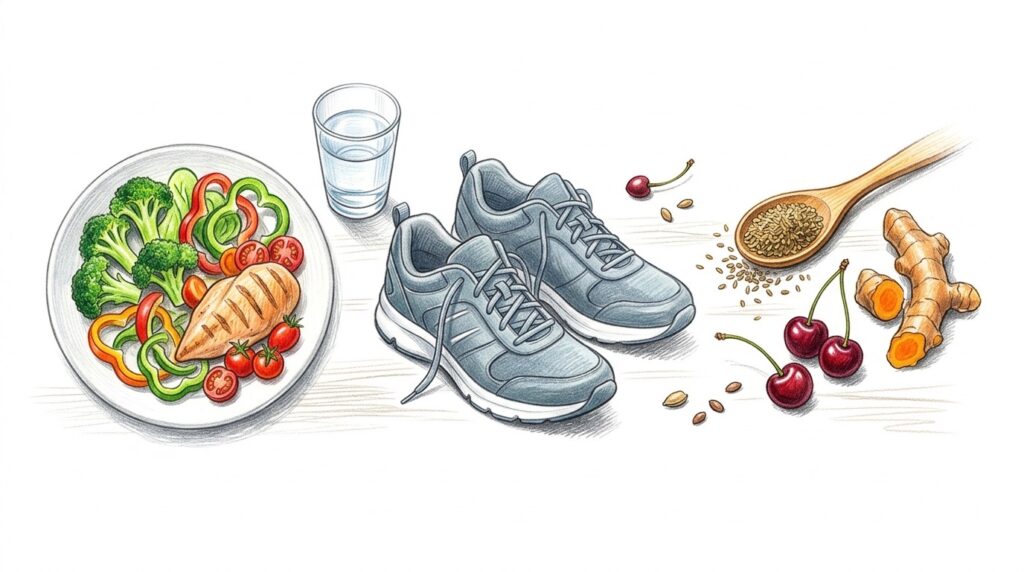
Gout management doesn’t need to be complicated.
There’s an entire industry built around making it seem like you need a PhD in biochemistry to manage your uric acid levels. You don’t. The fundamentals are straightforward, and if you get these three things right, you’ll be in a significantly better position than most people dealing with gout.
Step one: diet. Step two: exercise. Step three: supplementation.
That’s it. Let me break each one down.
Step 1: Fix Your Diet
Your diet has a direct, measurable impact on your uric acid levels. What you eat either pushes those levels up or helps bring them down. There’s no getting around this.
You don’t need to follow some elaborate meal plan or eliminate entire food groups. You need to make smarter choices consistently.
What to Eat More Of
Load up. Seriously. Vegetables are your best friend when it comes to gout management. Even the ones that are technically higher in purines, like spinach and mushrooms, don’t seem to increase gout risk according to the research. Fill half your plate with vegetables at every meal.
Lean proteins.
Chicken, turkey, eggs, and low-fat dairy are all solid choices. They give you the protein you need without the heavy purine load of red meat and organ meats.
Water.
I know water isn’t food, but it belongs in this section because it’s the single most important dietary factor for uric acid management. Your kidneys need adequate hydration to flush uric acid efficiently. In the Australian climate, aim for at least 2 to 3 litres daily. More if you’re active or it’s hot.
Cherries and berries.
Research supports tart cherries specifically for uric acid support. They contain compounds that may help reduce uric acid levels and inflammation. Fresh, frozen, or as juice, just watch the sugar content in commercial cherry juices.
Low-fat dairy.
Yoghurt, milk, and cheese may actually help lower uric acid levels. The proteins in dairy appear to support uric acid excretion.
What to Cut Back On
You don’t have to give it up entirely, but daily steaks and lamb chops are pushing your uric acid in the wrong direction. Once or twice a week is a more sensible frequency.
Oily fish and seafood.
Sardines, anchovies, mackerel, scallops, and mussels are all high in purines. Choose lower-purine fish like salmon or barramundi instead, and keep portions moderate.
Organ meats.
Liver, kidney, sweetbreads. These are the highest-purine foods you can eat. If you’re serious about managing gout, these need to go.
Beer is the worst drink for gout. It’s high in purines, it dehydrates you, and it blocks your kidneys from excreting uric acid. Three problems in one glass. If you’re going to drink, wine is a better option. But cutting back overall makes the biggest difference.
Sugar and soft drinks.
Fructose directly increases uric acid production. Soft drinks, fruit juices with added sugar, and processed sweets are all working against you. This is one of the most underestimated gout triggers in the Australian diet.
The Practical Reality
You don’t need to eat perfectly. You need to eat better than you’re eating now, consistently.
Swap the meat pie for a chicken salad once or twice a week. Throw some extra veggies on the barbie alongside the snags. Drink a glass of water for every beer. Small, sustainable changes add up to significant results.
Step 2: Get Moving
Exercise supports gout management in multiple ways, and most people dealing with gout aren’t doing nearly enough of it.
Why Exercise Matters
Weight management.
Excess body weight increases uric acid production and reduces your kidneys’ ability to clear it. Even modest weight loss of 5 to 10 per cent of body weight can significantly reduce uric acid levels.
Improved circulation.
Better blood flow supports your kidneys in filtering and excreting uric acid.
Blood pressure.
Regular exercise helps maintain healthy blood pressure, which is closely linked to kidney function and uric acid levels.
Stress reduction.
Chronic stress increases inflammation and can trigger gout flare-ups. Exercise is one of the most effective stress management tools available.
What to Do
Start with walking. It’s free, it’s low-impact, and you can do it anywhere.
If you’re currently inactive, begin with 10 to 15 minutes daily and build up gradually. The goal is 30 minutes of moderate exercise at least five days a week.
Other good options:
- Swimming (excellent for people with joint issues)
- Cycling
- Light resistance training
- Yoga or stretching
The key is consistency. A 20-minute walk five days a week beats a two-hour gym session once a month.
During a Flare-Up
Don’t exercise through an active gout attack. Rest the affected joint, use ice, and wait until the inflammation subsides before resuming activity. Pushing through a flare-up doesn’t make you tough; it makes the recovery longer.
Once the attack has resolved, ease back into your routine gradually.
Step 3: Supplementation
Diet and exercise are the foundation. Supplementation is the third piece that helps fill the gaps.
Several natural ingredients have research supporting their role in uric acid management:
One of the most well-studied natural ingredients for uric acid support. Tart cherries contain anthocyanins and other compounds that may help reduce uric acid levels and support a healthy inflammatory response.
Has been used for centuries in traditional medicine for joint health. Research suggests it may support healthy uric acid levels and kidney function.
Chanca piedra.
A tropical plant used in traditional medicine across multiple cultures. “Chanca piedra” translates to “stone breaker,” and it’s been studied for its potential to support kidney health and uric acid processing.
These ingredients work best as part of a consistent daily routine, not as a reactive measure when you’re already in the middle of a flare-up.
Why I Created URICAH
I created URICAH because I wanted a single supplement that combined the most effective natural ingredients for uric acid support in one formula.
URICAH contains 14 clearly labelled natural ingredients, including tart cherry, celery seed, and chanca piedra, along with other ingredients that support healthy uric acid levels. Every ingredient and its dosage is listed on the label. No proprietary blends. No mystery formulas.
Over 2,200 customers have reviewed it. It comes with a 90-day money-back guarantee and free shipping across Australia.
Supplementation isn’t a replacement for diet and exercise. It’s the third leg of the stool. All three together give you the strongest foundation for managing gout long-term.
Putting It All Together
Three steps. That’s the framework.
- Diet. More vegetables, lean proteins, and water. Less red meat, organ meats, beer, and sugar.
- Exercise. Daily movement, building to 30 minutes five days a week. Start with walking.
- Supplementation. Consistent daily support with ingredients that help your body manage uric acid.
None of these steps are complicated. None of them require expensive equipment or specialist knowledge. They require consistency and commitment.
Gout is manageable. The people who struggle with it most are the ones who do nothing between flare-ups and hope for the best. Don’t be that person.
Start today. Pick the easiest change you can make from each step and do it. Then build from there.
This article is for informational purposes only and is not intended as medical advice. Consult your healthcare provider before making changes to your health routine.


Giving the gout control tabs a go and so is a sufferer that I work with. I am starting on one tablet a day. He is about to start as well. Be interesting to see the results as we both suffer from the bloody horrible gout attacks