
There’s a mineral that most adults are deficient in, and it has a documented connection to gout.
Magnesium.
Large-scale population studies consistently link low magnesium intake with higher uric acid levels. Given that over half the population doesn’t get enough magnesium, this is worth paying attention to.
Here’s what the research says, how it connects to gout, and what to do about it.
What the Population Data Shows
The National Health and Nutrition Examination Survey (NHANES) is one of the largest health datasets available. It tracks tens of thousands of people through comprehensive health assessments.
Multiple analyses of NHANES data have found a clear inverse relationship between magnesium intake and serum uric acid levels.
People with higher magnesium intake tend to have lower uric acid.
People with lower magnesium intake tend to have higher uric acid.
A 2015 analysis found this association held even after adjusting for age, sex, BMI, kidney function, and other variables. The relationship was consistent across subgroups.
For gout specifically, this matters because uric acid levels above the saturation point are what cause urate crystals to form in your joints. Anything that reliably influences uric acid levels is worth understanding.
How Magnesium Connects to Gout
The connection works through several pathways.
Kidney function.
Your kidneys excrete roughly two-thirds of the uric acid your body produces. Magnesium plays a direct role in the transport systems that move uric acid from blood into urine.
Low magnesium impairs these transport systems. Uric acid excretion slows. Blood levels climb. Crystal formation becomes more likely.
Inflammation.
Gout is fundamentally an inflammatory condition. When urate crystals form in joints, your immune system launches an aggressive inflammatory response. That’s what causes the pain, swelling, and redness of a flare-up.
Magnesium helps regulate inflammatory pathways, including NF-kB, which is directly involved in the gout inflammatory cascade. Low magnesium is associated with higher baseline inflammation, measured by C-reactive protein.
Starting from a state of higher inflammation makes gout flare-ups more intense and harder to resolve.
Insulin resistance.
Magnesium deficiency is linked to insulin resistance. Insulin resistance reduces the kidneys’ ability to excrete uric acid. This creates an indirect but well-established pathway from low magnesium to elevated uric acid.
This also connects to the relationship between gout and diabetes, which share common metabolic roots.
Xanthine oxidase.
Early research suggests magnesium may influence xanthine oxidase activity, the enzyme responsible for uric acid production. This is the same enzyme targeted by medications like allopurinol. The evidence here is preliminary but worth noting.
The Deficiency Problem
Here’s why this matters so much practically.
Estimates suggest 50-80% of adults don’t meet recommended magnesium intake. Some researchers consider it the most widespread nutritional deficiency in developed countries.
Modern Australian diets have become lower in magnesium over the past few decades. Processed foods, refined grains, and lower intake of nuts, seeds, and leafy greens have all contributed.
Stress makes it worse. Stress depletes magnesium. Low magnesium increases your stress response. It becomes a self-reinforcing cycle.
Common signs of magnesium deficiency overlap significantly with what many gout patients report:
- Muscle cramps and twitching
- Poor sleep
- Fatigue and low energy
- Anxiety and irritability
- Headaches
Correcting a deficiency doesn’t just potentially help uric acid levels. It often makes people feel substantially better overall.
Choosing the Right Form
The form of magnesium you take determines how much your body actually absorbs.
Magnesium citrate.
Good absorption. Widely available. May have a mild laxative effect at higher doses. A solid all-round choice.
Magnesium glycinate.
Excellent absorption. Very gentle on the stomach. The glycine also supports relaxation and sleep quality. Best option for evening use.
Magnesium oxide.
The cheapest option, and the most common in supermarket supplements. Only about 4% bioavailability. Mostly a waste of money for anything other than treating constipation.
Magnesium taurate.
Well absorbed. Taurine provides additional cardiovascular support, which is relevant given the connection between gout and heart disease.
For gout support, go with magnesium citrate or magnesium glycinate. They give you the best absorption for the cost.
Getting the Dose Right
The recommended daily allowance is 400-420mg for adult men and 310-320mg for adult women.
Even with a decent diet, most people get only 200-300mg from food.
Supplemental dose: 200-400mg daily, on top of dietary intake.
Start low. Begin with 200mg and increase over a week or two. This gives your digestive system time to adjust.
Take with food. Better absorption and less chance of stomach upset.
Split your dose. If taking more than 200mg, divide it into two doses. Your body absorbs smaller amounts more efficiently.
Allow time. Magnesium levels take 4-6 weeks of consistent supplementation to meaningfully improve. Don’t expect overnight changes.
Being Upfront About URICAH
I want to be transparent here.
URICAH doesn’t contain magnesium.
When I formulated URICAH, I focused on 14 ingredients that directly target uric acid through specific mechanisms. Tart cherry extract and quercetin for xanthine oxidase inhibition. Celery seed extract and chanca piedra for kidney excretion support. Vitamin C, bromelain, and turmeric for anti-inflammatory action.
Magnesium works at a different level. It’s a foundational mineral that supports overall health and helps create the conditions for uric acid management to be more effective.
The two work well together.
URICAH targets gout directly. Magnesium fills a nutritional gap that most people have and that indirectly affects uric acid. Together, they cover more ground.
Food Sources Worth Adding
Supplements are useful, but food sources matter too.
Magnesium-rich foods:
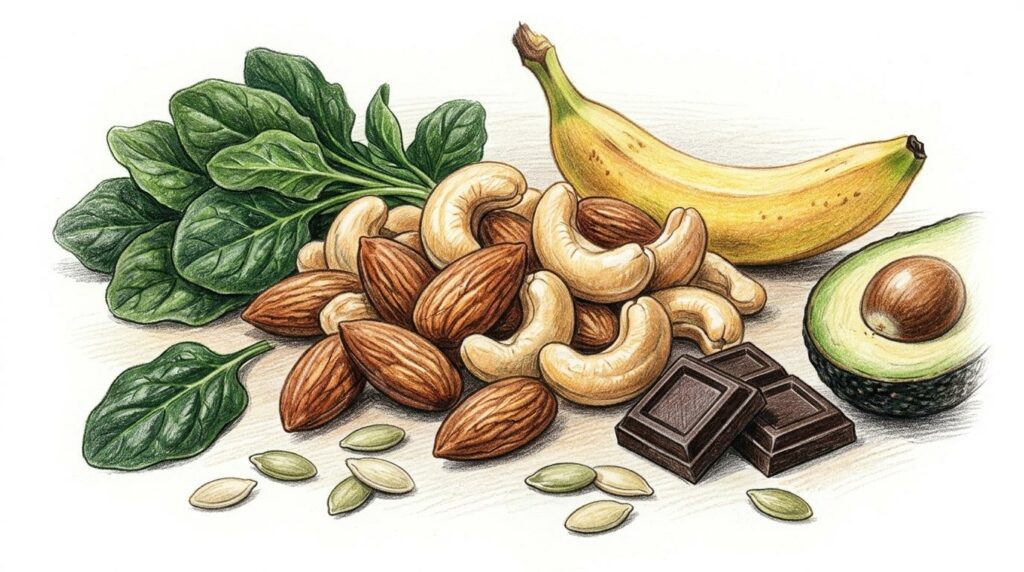
- Pumpkin seeds (156mg per 30g serve)
- Almonds (80mg per 30g serve)
- Spinach (78mg per 100g cooked)
- Dark chocolate (65mg per 30g)
- Avocado (58mg per whole avocado)
- Black beans (60mg per 100g cooked)
- Bananas (32mg per banana)
Building these into your weekly meals supports magnesium levels and provides additional fibre, antioxidants, and other nutrients that help with overall health and gout management.
None of these are high-purine foods, so they fit comfortably into a gout-friendly eating plan.
Who Should Check with Their Doctor First
Magnesium supplementation is safe for most people, but some should get medical advice first.
Kidney disease. Impaired kidneys may not excrete magnesium properly, which can cause dangerous accumulation.
Medications. Magnesium can interact with antibiotics, bisphosphonates, certain diuretics, and proton pump inhibitors. Talk to your pharmacist.
Very high doses. Staying above 400mg supplemental magnesium can cause diarrhoea, nausea, and cramping. More is not better with magnesium.
The Bottom Line
Magnesium won’t cure gout on its own. No single supplement will.
But the evidence linking magnesium deficiency to higher uric acid levels is consistent and comes from large, well-designed studies. Most people are deficient. Correcting that deficiency supports kidney function, reduces baseline inflammation, and helps create better conditions for managing gout.
Take 200-400mg daily of magnesium citrate or glycinate. Increase your intake of magnesium-rich foods. Give it time to work.
Pair it with a comprehensive gout management approach that targets uric acid directly, and you’re setting yourself up to make real progress.
See the full URICAH ingredient list
Try URICAH with a 90-day money-back guarantee
This article is for informational purposes only and is not intended as medical advice. Consult your healthcare provider before making changes to your health routine.

URICAH! Uric Acid Support
4.85 / 5
read 2,290 customer reviews
$39 AUDTHIS IS YOUR URICAH MOMENT
Our 14 potent, natural ingredients support the body in lowering uric acid levels, alleviating the excruciating pain and discomfort caused by gout.
URICAH™ features powerful ingredients used over thousands of years to fight gout such as Tart Cherry, Celery Seed and Chanca Piedra.
Get back on your feet and live pain free with URICAH™.
LEARN MORE