
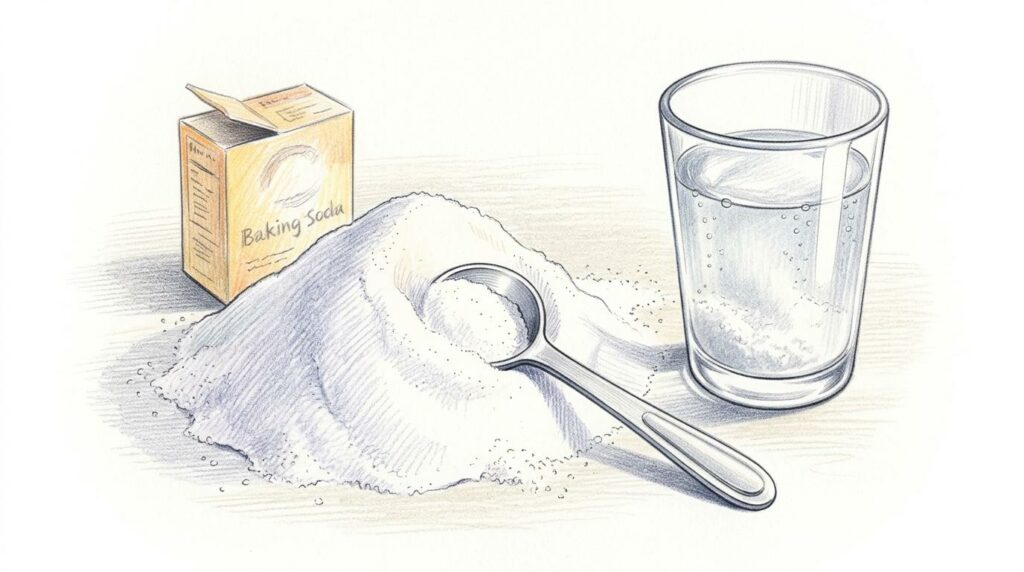
Baking soda is one of the oldest home remedies for gout you’ll find online.
The advice is always the same. Half a teaspoon of bicarbonate of soda in a glass of water. Drink it before bed. Your gout will improve.
The theory behind it actually makes some sense. That’s what makes it convincing.
But the evidence doesn’t support it, and the risks are more significant than most websites will tell you. Here’s the full picture.
How Baking Soda Is Supposed to Help Gout
The logic works like this.
Gout happens when uric acid crystallises in your joints. Your kidneys are responsible for removing about two-thirds of the uric acid your body produces.
Uric acid is more soluble in alkaline conditions. Sodium bicarbonate (baking soda, bicarbonate of soda) is alkaline. Drink it dissolved in water, your urine becomes more alkaline, and theoretically your kidneys excrete uric acid more efficiently.
Less uric acid in the blood. Fewer crystals. Fewer flare-ups.
That’s the theory. And the first part is technically correct. Sodium bicarbonate does raise urine pH.
But raising urine pH and actually reducing gout are very different claims.
What the Research Shows
Zero clinical trials have tested baking soda as a gout treatment. Despite decades of people recommending it online, not a single randomised controlled trial has been published.
That’s a significant gap.
Urine pH doesn’t equal blood levels.
Your uric acid levels are determined by the balance between production and excretion. Slightly shifting urine pH doesn’t necessarily create a meaningful change in your serum uric acid. The body is more complicated than that.
Medical alkalisation is done under supervision.
When doctors do use urinary alkalisation, it’s in controlled clinical settings with blood monitoring, electrolyte checks, and careful dosing. It’s used for specific conditions like certain kidney stones. It’s not a gout strategy, and it’s nothing like the DIY version circulating online.
No guidelines recommend it.
The Australian Rheumatology Association doesn’t recommend baking soda for gout. Neither does EULAR, the ACR, or any major clinical body. When something genuinely works, it ends up in guidelines. Baking soda hasn’t.
The Risks Are Real
This is where the advice to “just try it” becomes genuinely concerning.
Metabolic alkalosis.
Your blood pH sits in a narrow range between 7.35 and 7.45. Regular sodium bicarbonate consumption can push it too high. Case reports published in PMC (2022) document metabolic alkalosis from chronic baking soda use, resulting in muscle twitching, tremors, nausea, and cardiac arrhythmias.
People have ended up in emergency departments from this.
Sodium overload.
Half a teaspoon of baking soda adds roughly 630mg of sodium. Twice daily, that’s 1,260mg of extra sodium on top of your normal diet.
This matters enormously because gout and high blood pressure are frequently linked. Many people with gout already need to watch their sodium intake. Adding over a gram daily is counterproductive at best, dangerous at worst.
Medication interactions.
Sodium bicarbonate can change how your body absorbs medications. This includes common prescriptions like blood pressure medications, certain antibiotics, aspirin, and lithium. If you’re taking allopurinol or other gout medications, you should talk to your doctor before adding baking soda to the mix.
Digestive issues.
Baking soda neutralises stomach acid. Done regularly, this can impair digestion, reduce nutrient absorption, and cause bloating, gas, and discomfort. Your stomach acid is there for good reasons.
Kidney strain.
Gout already places additional burden on your kidneys. Adding extra sodium and forcing pH adjustments creates more work for organs that may already be under stress.
Why People Still Recommend It
Three reasons, mainly.
It’s cheap and available. Everyone has baking soda at home. The barrier to trying it is essentially zero.
The theory sounds right. Alkaline urine, better excretion, less gout. It’s a clean, simple story. Simple stories spread well, even when they’re incomplete.
Anecdotes fill the evidence gap. Someone on a forum says it helped them. That post gets shared hundreds of times. Nobody follows up with blood tests or long-term outcomes. Nobody accounts for the other changes that person made at the same time.
I understand the appeal. When you’re dealing with gout flare-ups, you’ll try anything to find relief. That instinct makes complete sense.
But “anything” should still be safe and evidence-based.
How This Compares to Apple Cider Vinegar
The baking soda story is similar to the apple cider vinegar for gout story.
Both are hugely popular online. Both have plausible-sounding theories. Neither has clinical trial evidence for reducing uric acid or managing gout.
The key difference is risk. ACV is relatively safe for most people. Baking soda carries genuine medical risks with regular use, especially for people with hypertension, kidney issues, or those taking medications.
Between the two, ACV is the safer option. But neither should be your primary gout strategy.
What the Evidence Actually Supports
There are natural approaches to gout management that have real research behind them. You don’t need to gamble on kitchen remedies.
The most studied natural ingredient for gout. Research shows it inhibits xanthine oxidase, the enzyme that produces uric acid. It also provides anti-inflammatory support during flare-ups.
Meta-analyses of randomised controlled trials demonstrate that 500mg daily supports uric acid excretion. This is real evidence from proper clinical trials.
Supports kidney function, provides anti-inflammatory benefits, and contains compounds that may help inhibit xanthine oxidase. Long traditional use supported by modern research.
Hydration
Drinking enough water consistently is one of the most effective things you can do for uric acid excretion. Simple, safe, and backed by evidence.
A comprehensive natural approach
Gout responds best to multiple strategies working together. Diet, hydration, targeted supplementation, and lifestyle changes.
A Proper Multi-Ingredient Approach
Gout management isn’t a one-ingredient fix.
You need to address uric acid production, support excretion, and manage the inflammatory response. No single home remedy covers all three.
That’s exactly why I created URICAH. It contains 14 natural ingredients at fully transparent dosages. Tart cherry extract, celery seed extract, vitamin C, bromelain, turmeric, chanca piedra, green coffee bean extract, and more. Every ingredient selected based on published research. No proprietary blends. Nothing hidden.
Over 2,200 customer reviews and a 90-day money-back guarantee. Free shipping across Australia.
The Bottom Line
Baking soda does raise urine pH. That’s real.
But no clinical trials show it reduces serum uric acid or prevents gout flare-ups. And the risks of regular use, including metabolic alkalosis, sodium overload, medication interactions, and kidney strain, are too serious to ignore.
Bicarbonate of soda belongs in your baking, not in your gout management plan.
Focus on what the research actually supports. Your joints, your kidneys, and your long-term health are worth more than an untested home remedy.
See the full URICAH ingredient list
Try URICAH with a 90-day money-back guarantee
This article is for informational purposes only and is not intended as medical advice. Consult your healthcare provider before making changes to your health routine.

URICAH! Uric Acid Support
4.85 / 5
read 2,290 customer reviews
$39 AUDTHIS IS YOUR URICAH MOMENT
Our 14 potent, natural ingredients support the body in lowering uric acid levels, alleviating the excruciating pain and discomfort caused by gout.
URICAH™ features powerful ingredients used over thousands of years to fight gout such as Tart Cherry, Celery Seed and Chanca Piedra.
Get back on your feet and live pain free with URICAH™.
LEARN MORE