
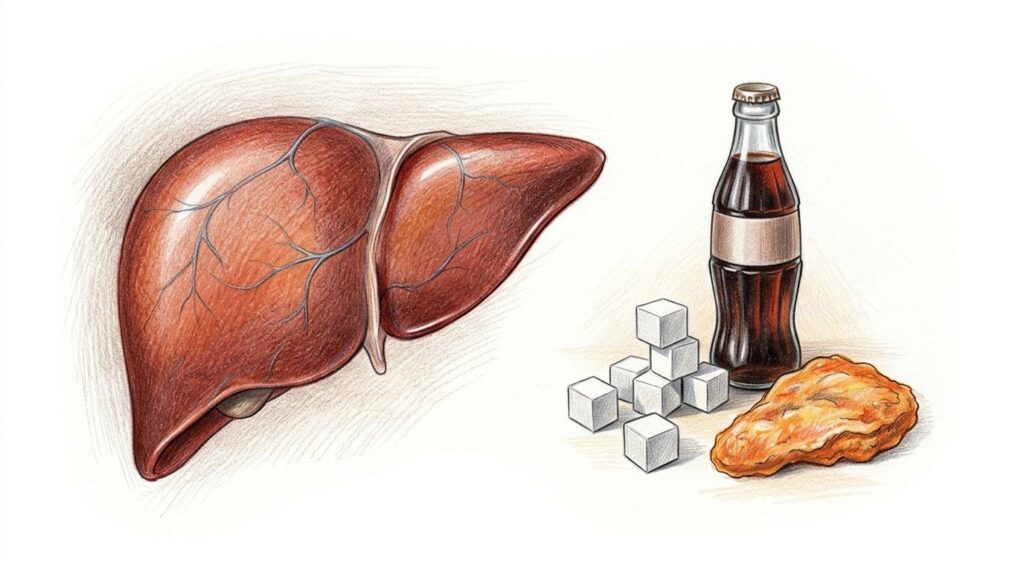
Here is a number worth knowing: 60% of people with gout also have fatty liver disease.
In the general population, the rate sits around 29%.
That is not a coincidence. These conditions share the same metabolic machinery. They develop through the same pathways. And they reinforce each other in ways that most people, and many doctors, are only beginning to appreciate.
What is fatty liver disease?
Non-alcoholic fatty liver disease (NAFLD) is the buildup of excess fat in liver cells in people who drink little or no alcohol.
It is the most common liver condition in the Western world. Roughly one in four adults globally has it.
Most people with early-stage fatty liver have no symptoms. The condition is typically discovered through routine blood tests showing elevated liver enzymes or through imaging done for another reason.
But fatty liver is not benign. It can progress to non-alcoholic steatohepatitis (NASH), where the liver becomes inflamed and scarred. In severe cases, this leads to cirrhosis and liver failure.
In Australia, fatty liver rates are rising sharply alongside obesity and metabolic syndrome.
Why gout and fatty liver cluster together
The 60% overlap is not random. There are specific biological reasons these conditions appear together.
Insulin resistance is the common denominator
Both gout and fatty liver are driven by insulin resistance.
When your cells stop responding normally to insulin, your pancreas compensates by producing more. This excess insulin has consequences for both conditions.
For uric acid: insulin tells your kidneys to reabsorb more uric acid instead of excreting it. Your levels rise even if you are not producing more uric acid than normal.
For your liver: insulin resistance promotes fat accumulation in liver tissue. The liver converts excess glucose into fat and stores it in its own cells.
Same metabolic dysfunction. Two different organs paying the price.
We cover the insulin-uric acid relationship in our guide on gout and diabetes.
Fructose is the shared fuel
Fructose deserves special attention because it drives both conditions through a single metabolic pathway.
When your liver processes fructose, it burns through ATP (cellular energy) at a rapid rate. The breakdown products of ATP include purines, which are converted to uric acid.
But that same fructose metabolism also directly drives fat production in the liver. Fructose bypasses the normal controls on fat synthesis, a process called de novo lipogenesis. Your liver converts fructose straight into stored fat.
One substance. Two problems. Fructose is simultaneously raising your uric acid and fattening your liver.
This is why reducing fructose intake, particularly from soft drinks, fruit juices, and processed foods, is one of the most impactful things you can do if you have both conditions.
Uric acid directly promotes liver fat
The connection goes beyond shared causes.
Research published in the Journal of Hepatology found that uric acid activates fat-producing enzymes inside liver cells. Elevated uric acid tells your liver to make and store more fat.
This means gout is not just associated with fatty liver. The underlying high uric acid is actively contributing to fat buildup in your liver.
Animal studies confirm that lowering uric acid reduces liver fat content, even without changes to diet or body weight. Human research is ongoing, but the mechanism is consistent.
Fatty liver produces more uric acid
The cycle runs both ways.
Your liver is where uric acid is produced. The enzyme responsible for the final step, xanthine oxidase, is concentrated in liver tissue.
When the liver is fatty and inflamed, xanthine oxidase activity increases. A fatty liver produces more uric acid than a healthy one.
More uric acid promotes more liver fat. More liver fat promotes more uric acid. The feedback loop is self-sustaining.
Oxidative stress compounds the damage
Both conditions generate oxidative stress, an imbalance between harmful free radicals and your body’s ability to neutralise them.
Uric acid produces reactive oxygen species inside cells. Fatty liver triggers inflammatory immune responses to the excess fat.
These inflammatory signals amplify each other, accelerating damage and driving the progression from simple fatty liver to the more serious NASH.
What the latest research says
The science on this connection is advancing quickly.
A 2023 study in Clinical Rheumatology examined gout patients and found fatty liver at more than double the rate seen in matched controls, even after accounting for BMI, alcohol use, and other metabolic factors.
Research from Georgia State University published in 2025 identified shared genetic pathways between uric acid metabolism and liver fat regulation. This suggests some people are genetically predisposed to both conditions through the same biological circuits.
A meta-analysis of prospective studies found that every 1 mg/dL increase in serum uric acid raised the risk of developing NAFLD by 21%.
These are not weak associations. They are strong, consistent, dose-dependent relationships confirmed across multiple populations and study designs.
Who should pay attention?
The overlap is most pronounced in people who also have one or more of the following.
- Central obesity (weight concentrated around the midsection)
- Insulin resistance or type 2 diabetes
- Elevated triglycerides
- High blood pressure
- High fructose or sugar intake
- Sedentary lifestyle
If you have gout and fit this profile, asking your doctor about a liver check is a smart move. A liver function blood test and abdominal ultrasound are straightforward screening tools.
For more on these interconnected conditions, see our guides on gout and heart disease and gout and high blood pressure.
Practical strategies that help both
Because these conditions share root causes, the same interventions tend to improve both.
Cut fructose aggressively
This is the most targeted action for the gout-fatty liver connection.
Eliminate sugary drinks and fruit juice. Read labels on packaged foods for added sugars. Be aware that many “healthy” products like flavoured yoghurts and muesli bars contain significant fructose.
Whole fruit in moderate amounts is acceptable. The fibre slows fructose absorption and limits the metabolic damage. It is the concentrated, liquid forms that cause the most harm.
Lose weight gradually
Weight loss is one of the most effective interventions for both conditions.
Losing 5-10% of body weight significantly reduces liver fat. It also improves insulin sensitivity, which helps your kidneys clear more uric acid.
But the rate of weight loss matters enormously. Crash dieting causes rapid cellular breakdown, floods your bloodstream with purines, and spikes uric acid. It can also worsen liver inflammation in the short term.
Aim for 0.5 to 1 kilogram per week. Slow is not just safer. It is more effective long-term.
Our guide on obesity, weight, and gout covers the right approach.
Exercise regularly
Exercise improves insulin sensitivity independently of weight loss.
It also reduces liver fat directly. Research shows that both aerobic exercise and resistance training lower liver fat content, even without significant changes on the scale.
Aim for at least 150 minutes of moderate-intensity activity per week. Walking, cycling, and swimming are all effective.
Stay hydrated
Proper hydration supports kidney function and uric acid excretion.
Aim for at least 2 litres of water per day. More if you are active or in warm weather.
Our guide on dehydration and gout explains why this matters.
Reduce alcohol
Alcohol is processed by your liver. It contributes to fat accumulation in liver tissue and increases uric acid production.
Even moderate alcohol intake can worsen fatty liver. If you have both conditions, reducing or eliminating alcohol is one of the highest-impact changes you can make.
Consider natural support
Certain natural compounds may help support healthy uric acid levels. Tart cherry, quercetin, and vitamin C have research behind them.
See our guide on natural ways to manage gout for evidence-based options.
Get the right tests
If you have gout, ask your doctor to check for fatty liver. If you have fatty liver, ask to have your uric acid levels tested.
Understanding your uric acid levels is essential for managing either condition effectively.
Bringing it together
Gout and fatty liver are not separate conditions that happen to overlap.
They are two manifestations of the same metabolic dysfunction. Insulin resistance drives both. Fructose fuels both. And they amplify each other through direct biological feedback loops.
The encouraging news is that you do not need a separate plan for each. Reducing fructose, managing weight, exercising, and improving insulin sensitivity addresses both conditions at their shared root.
One coherent approach. Two conditions improved.
This article is for informational purposes only and is not intended as medical advice. Consult your healthcare provider before making changes to your health routine.

URICAH! Uric Acid Support
4.85 / 5
read 2,290 customer reviews
$39 AUDTHIS IS YOUR URICAH MOMENT
Our 14 potent, natural ingredients support the body in lowering uric acid levels, alleviating the excruciating pain and discomfort caused by gout.
URICAH™ features powerful ingredients used over thousands of years to fight gout such as Tart Cherry, Celery Seed and Chanca Piedra.
Get back on your feet and live pain free with URICAH™.
LEARN MORE