
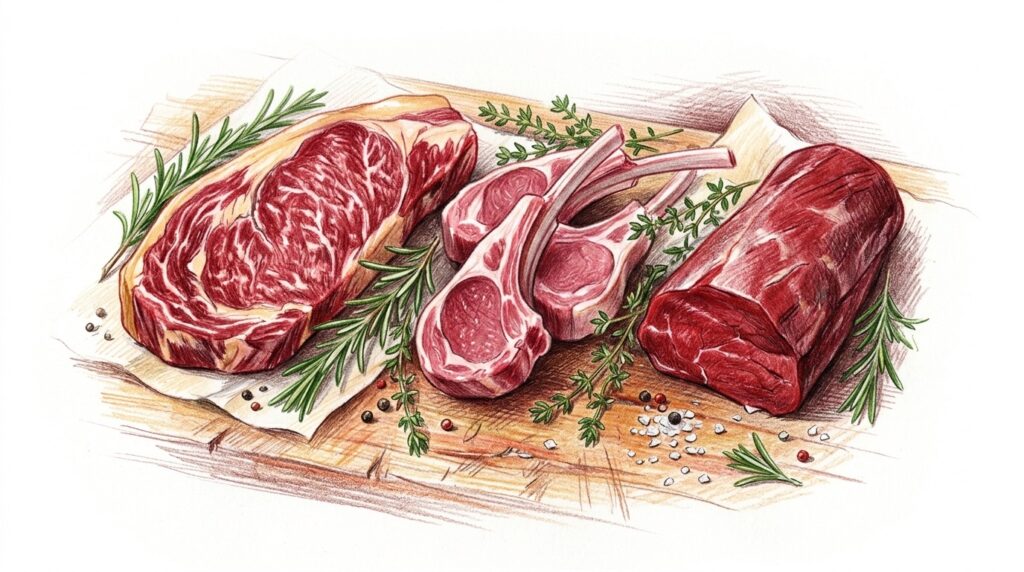
Red meat and gout. It’s probably one of the first things you Googled after your diagnosis.
The answer matters, because red meat sits at the centre of Australian food culture. Weekend lamb on the barbie. A proper beef steak on a Friday night. Kangaroo steaks for the health-conscious.
The short version: red meat is higher in purines than chicken or fish, but you don’t need to give it up entirely.
You need to know which red meats are riskier, how much is reasonable, and which ones belong on the high-purine foods list permanently.
Why Red Meat Is Higher in Purines Than White Meat
Red meat is rich in myoglobin, the protein that gives it its colour and helps muscles store oxygen.
More myoglobin means more cell nuclei, more DNA, and more purines. That’s why beef, lamb, kangaroo, and venison all sit higher on the purine scale than chicken breast or pork loin.
Wild game like kangaroo and venison have leaner, harder-working muscles, which can mean higher purine density per gram compared to farmed beef or lamb.
None of this makes red meat dangerous on its own. But it does mean you need to manage it more carefully than lighter proteins.
Red Meats Ranked by Purine Risk
Not all red meats carry the same risk. Here’s how they stack up, from moderate to genuinely problematic.
Beef (Moderate Risk)
Purine level: moderate, roughly 100-130mg per 100g for lean cuts
Beef is the most common red meat in Australian kitchens, and it’s manageable for most people with gout. Stick with lean cuts like eye fillet, rump, or sirloin. Avoid heavily marbled cuts and fatty ribeyes.
A lean steak once or twice a week is reasonable for most people.
Lean beef mince is fine too. Just make sure you’re buying lean or extra-lean. Standard mince has higher fat content, which adds to the problem.
Lamb (Moderate to Higher Risk)
Purine level: moderate to high, roughly 100-150mg per 100g depending on the cut
Lamb is a staple in Australia, especially on the barbie. The issue is that lamb tends to carry more fat than beef, and fattier cuts generally have more purines.
Lean lamb leg or trimmed loin chops are your best options. Lamb shoulder, shanks, and untrimmed cutlets are riskier.
Keep lamb to once a week and stick with lean cuts. Trim visible fat before cooking.
Kangaroo (Moderate to Higher Risk)
Purine level: moderate to high, roughly 120-150mg per 100g
Kangaroo is marketed as the healthier red meat because it’s extremely lean. And it is.
But lean doesn’t automatically mean low-purine. Kangaroo has dense, hard-working muscle tissue, which means its purine content is similar to or slightly higher than beef.
Don’t assume you can eat unlimited kangaroo steaks because they’re low in fat. Once a week, around 100-120g, is a sensible limit.
Venison and Other Game Meats (Higher Risk)
Purine level: high, roughly 130-160mg per 100g
Venison, wild boar, and other game meats are similar to kangaroo. Very lean, very nutrient-dense, but higher in purines than farmed beef or lamb.
If you enjoy game meats, treat them as an occasional option rather than a regular rotation. Once a fortnight is a safer approach if you’re prone to flare-ups.
Organ Meats (Avoid Entirely)
Purine level: very high, 200-400mg+ per 100g
Liver, kidneys, sweetbreads, heart, and offal of any kind are the highest-purine foods you can eat. It doesn’t matter whether it’s beef liver, lamb kidneys, or chicken livers. Organ meats are concentrated purine bombs.
There is no safe amount if you’re managing gout. Take them off the menu entirely. That includes pate, liverwurst, and anything made from offal.
How Much Red Meat Can You Eat?
The practical guidelines are straightforward:
- Keep portions to around 100-120g per serve (roughly the size of your palm)
- Limit red meat to two or three serves per week
- Balance your protein across the week with lower-purine options like chicken, eggs, and fish
- Fill the rest of your plate with vegetables
If you’re in the middle of a flare-up, drop red meat completely until it settles. Stick with chicken, eggs, and plant-based protein until things calm down.
Best Ways to Prepare Red Meat
How you cook it matters more than most people realise.
Trim the fat first
Cut off all visible fat before cooking. The fat doesn’t just add calories; it concentrates purines.
Grill, bake, or stir-fry
These methods let excess fat drain away. A lean steak on the barbie is a better choice than a slow-cooked fatty braise.
Avoid processed red meats
Sausages, salami, corned beef, and devon are made from fattier cuts and the processing concentrates purines. The Saturday snag on the barbie is part of Australian culture. I get it. But if gout is an issue, those snags need to go.
Don’t pair red meat with beer
A steak with a few beers is one of the worst combinations for gout. The alcohol impairs your kidneys’ ability to flush the uric acid from the meat’s purines. If you’re having red meat, skip the drink or keep it to a single glass of wine.
Drink water with your meal
Simple and effective. Water helps your kidneys process uric acid. Make it a habit.
The Bottom Line
Red meat isn’t off the table. But it needs more management than lighter proteins like chicken or seafood.
Stick with lean cuts of beef and lamb. Keep portions modest and frequency to a few times a week. Treat kangaroo and game meats as occasional options, not daily staples. And remove organ meats from your diet completely.
If you’re looking for additional support alongside dietary changes, I created URICAH with 14 clearly labelled natural ingredients to help support healthy uric acid levels. No proprietary blends, transparent dosages, 2,200+ customer reviews, and a 90-day money-back guarantee. Free shipping across Australia.
You can still enjoy a good steak. You just need to be smarter about how often and how much.
This article is for informational purposes only and is not intended as medical advice. Consult your healthcare provider before making changes to your health routine.

URICAH! Uric Acid Support
4.85 / 5
read 2,290 customer reviews
$39 AUDTHIS IS YOUR URICAH MOMENT
Our 14 potent, natural ingredients support the body in lowering uric acid levels, alleviating the excruciating pain and discomfort caused by gout.
URICAH™ features powerful ingredients used over thousands of years to fight gout such as Tart Cherry, Celery Seed and Chanca Piedra.
Get back on your feet and live pain free with URICAH™.
LEARN MORE