
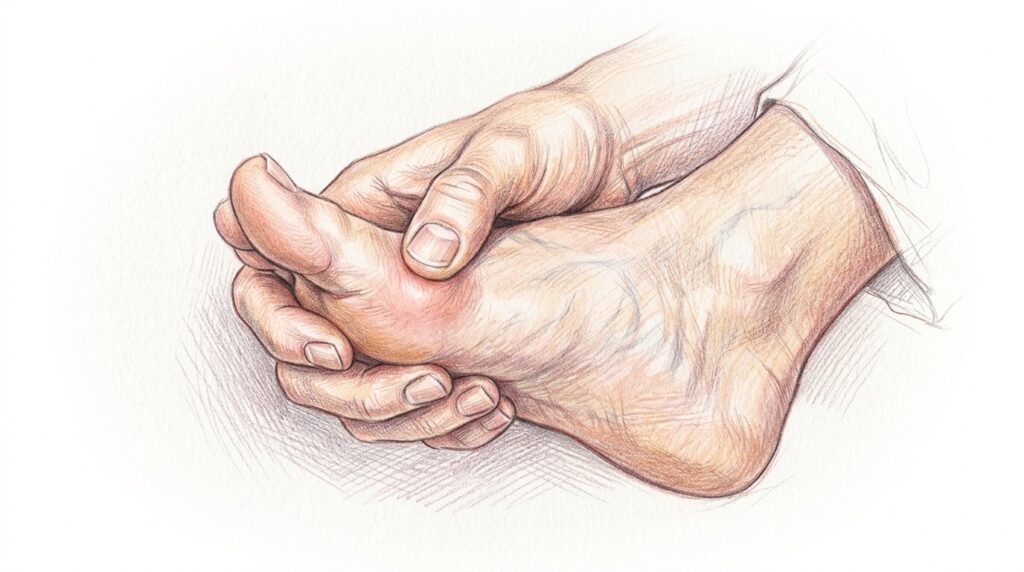
You’ve got pain in your foot, and you’re assuming it’s arthritis.
Maybe you’re even treating it like arthritis. Anti-inflammatories. Rest. Hoping it goes away.
What if it’s gout?
Gout gets misidentified as arthritis more often than you’d think. They’re both forms of joint inflammation, they can affect the same areas, and they both hurt. But they’re fundamentally different conditions with different causes, different triggers, and different management approaches.
Getting the wrong diagnosis means getting the wrong treatment.
Here’s how to tell which one you’re actually dealing with.
The Way It Starts Tells You a Lot
This is the biggest difference, and it’s the one most people notice first.
Gout strikes like lightning
You go to bed feeling completely normal.
At 2am, you wake up with a big toe (or ankle, or knee) that feels like someone’s taken to it with a blowtorch. The pain goes from zero to excruciating in a matter of hours, sometimes minutes. The symptoms are unmistakable once you know what to look for.
There’s no gradual buildup. No slow increase over weeks. It hits hard and fast.
Arthritis develops gradually
Osteoarthritis, the most common form, creeps up over months and years.
You notice stiffness in the morning that takes longer to wear off. A dull ache after walking. Gradually increasing discomfort. It’s a slow process of wear and tear.
Rheumatoid arthritis can have flare-ups, but even those tend to develop over days rather than hours, and they usually follow a pattern that’s different from gout’s sudden, explosive onset.
If your foot pain appeared overnight with no warning, gout should be at the top of your list.
The Pain Patterns Are Different
Gout pain is intense and localised
It’s focused on a specific joint, most commonly the big toe (the metatarsophalangeal joint, if your GP is being technical).
The pain is acute, severe, and concentrated. People describe it as needles, burning, or crushing. It’s hard to think about anything else when a gout attack is in full swing.
Arthritis pain is duller and more widespread
Osteoarthritis tends to produce a deep, aching pain that’s worse with activity and better with rest.
It often affects multiple joints, and the discomfort is more diffuse. You might have “bad days” and “good days,” but the pain rarely reaches the intensity of a gout attack.
Gout pain peaks and resolves
A gout attack typically peaks within 24 hours and resolves within one to two weeks, even without treatment.
Then you might be completely pain-free until the next attack. This episodic pattern is distinctive.
Arthritis pain is more constant
Osteoarthritis doesn’t go away.
It might fluctuate in severity, but it’s a persistent background presence that generally worsens over time.
What It Looks Like
The visual signs can help you distinguish between the two.
During a gout attack:
- Dramatic redness over the affected joint
- Significant, visible swelling
- Skin that feels hot to the touch
- The area may look shiny or stretched due to swelling
- Sometimes the skin peels as the attack resolves
With osteoarthritis:
- Possible mild swelling, but nothing like the dramatic puffiness of gout
- Rarely any redness or warmth
- Joint may appear enlarged or knobbly over time due to bone changes
- No acute visual changes that come and go
If your toe has gone bright red, swollen, and feels like it’s radiating heat, that’s a strong indicator of gout rather than arthritis.
The Timing Clue
Gout attacks follow patterns that arthritis doesn’t.
Night-time and early morning attacks are a hallmark of gout. Your body temperature drops while you sleep, and cooler temperatures in your extremities promote uric acid crystallisation. Waking up in pain between midnight and 4am is classic gout.
After certain meals or drinks. Had a big night of beer and barbecue? Enjoyed a seafood feast? These purine-heavy triggers can set off a gout attack within 24 to 48 hours. If you can trace your foot pain back to a specific dietary event, gout is the likely culprit.
After dehydration. A hot day where you didn’t drink enough water. A long flight. A big session without rehydrating. Dehydration concentrates uric acid in your blood and can trigger crystallisation.
Arthritis doesn’t follow these patterns. It gets worse with use and better with rest, but it’s not triggered by last night’s barramundi dinner.
What Triggers Each Condition
Gout triggers:
- High-purine foods (organ meats, sardines, scallops, red meat)
- Beer and alcohol
- Dehydration
- Sugar-sweetened drinks
- Rapid weight loss or crash diets
- Certain medications
- Stress
Arthritis triggers:
- Overuse or repetitive stress on joints
- Age-related wear and tear
- Previous joint injuries
- Obesity (added stress on weight-bearing joints)
If your foot pain flares up after dietary indulgences or alcohol, that pattern points strongly toward gout.
Getting the Right Diagnosis
The only way to know for certain is a medical consultation. Here’s what to expect.
Blood test for uric acid levels.
Elevated uric acid (above 0.43 mmol/L for men, 0.36 mmol/L for women) supports a gout diagnosis. However, uric acid levels can be normal during an acute attack, so a single test isn’t always definitive.
Joint fluid analysis.
The gold standard for gout diagnosis. Your doctor extracts a small amount of fluid from the affected joint and examines it under a microscope for uric acid crystals. If they’re there, it’s gout.
X-rays or imaging.
These can show joint damage patterns. Gout damage looks different from arthritis damage.
Medical history.
Family history of gout, dietary patterns, alcohol consumption, and the timing of your symptoms all help your GP make the right call.
Don’t self-diagnose and don’t assume. See your GP, get tested, and know what you’re dealing with.
Managing Gout (Once You Know That’s What It Is)
If your foot pain turns out to be gout, the management approach is different from arthritis in important ways.
Hydration is critical.
Drink at least 2 to 3 litres of water daily. In the Australian climate, more during summer. This is the simplest and most effective daily action you can take.
Dietary management matters.
Reducing high-purine foods and cutting back on beer and sugar directly affects your uric acid levels. This doesn’t apply to osteoarthritis in the same way.
Movement helps.
Regular, low-impact exercise supports weight management, kidney function, and circulation. Walking, swimming, and cycling are all excellent. Just don’t push through an active flare-up.
Stress management counts.
Stress can trigger gout attacks. Whatever helps you decompress, whether that’s a walk on the beach, fishing, golf, or just switching off for an hour, treat it as part of your gout management plan.
Natural supplementation.
I created URICAH with 14 clearly labelled natural ingredients that support healthy uric acid levels. It’s designed for daily use as part of a broader gout management approach. No proprietary blends, transparent dosages, over 2,200 customer reviews, a 90-day money-back guarantee, and free shipping across Australia.
Don’t Guess, Get Tested
Foot pain is common. Gout and arthritis are both common.
Treating one as if it’s the other wastes time and leaves the real problem unmanaged.
If your foot pain is sudden, severe, and comes with redness and swelling, don’t assume it’s “just arthritis.” Get your uric acid levels tested. If gout is the cause, you now have a clear, manageable path forward.
The sooner you know what you’re dealing with, the sooner you can do something effective about it.
This article is for informational purposes only and is not intended as medical advice. Consult your healthcare provider before making changes to your health routine.

URICAH! Uric Acid Support
4.85 / 5
read 2,290 customer reviews
$39 AUDTHIS IS YOUR URICAH MOMENT
Our 14 potent, natural ingredients support the body in lowering uric acid levels, alleviating the excruciating pain and discomfort caused by gout.
URICAH™ features powerful ingredients used over thousands of years to fight gout such as Tart Cherry, Celery Seed and Chanca Piedra.
Get back on your feet and live pain free with URICAH™.
LEARN MORE