
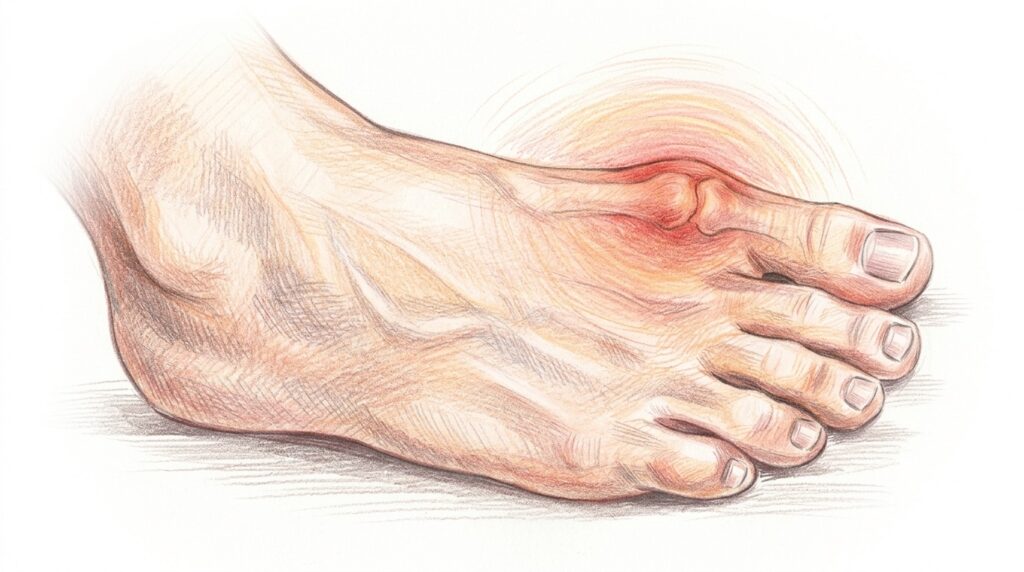
Most people learn about gout symptoms the hard way.
They wake up at 2am with a big toe that feels like it’s being crushed in a vice, and they have no idea what’s happening.
If that’s you, or if you’re trying to figure out whether your joint pain might be gout, here’s a clear breakdown of what gout looks like at every stage.
The Classic Gout Attack
A gout flare-up is hard to mistake for anything else once you’ve had one.
The symptoms are sudden, intense, and distinctive.
Severe joint pain.
The pain typically hits without warning, often in the middle of the night or early morning.
It peaks within 12 to 24 hours and can be absolutely debilitating.
“Even the weight of a bedsheet becomes unbearable” is something you’ll hear from gout sufferers over and over.
Swelling.
The affected joint swells noticeably.
Sometimes the swelling extends beyond the joint itself.
Redness and warmth.
The skin over the joint turns red or purplish and feels hot to the touch.
It can look infected, which is why some people end up in emergency departments thinking they have a wound infection.
Extreme sensitivity.
Any contact with the joint is painful.
Walking becomes almost impossible when the big toe is affected.
Wearing shoes is out of the question.
The big toe is the most common site for gout attacks, but gout can hit your ankles, knees, wrists, elbows, and fingers.
Some people get attacks in multiple joints at once.
Early Warning Signs Most People Miss
Before a full flare-up, your body often gives you signals.
Recognising them early gives you a chance to act.
Watch for:
- Persistent aching in a joint. A dull, nagging ache that doesn’t have an obvious cause, especially in your big toe, ankle, or knee.
- Random twinges. Brief, sharp pains that come and go. Easy to brush off as “just getting older.”
- Unusual fatigue. Chronic inflammation drains your energy even before a full attack develops.
- Mild swelling. Slight puffiness around a joint that you might not even notice unless you’re looking for it.
- Heightened sensitivity. A joint that feels tender or uncomfortable without any injury or obvious reason.
If you’re experiencing any of these and you have risk factors for gout (family history, diet high in purines, excess weight, regular alcohol consumption), don’t wait for the full attack.
Get your uric acid levels tested.
How Gout Progresses
Gout isn’t a one-and-done event.
Without management, it follows a predictable escalation.
Initial episodes.
Your first attack might last a few days.
It resolves on its own.
You might go months or even a couple of years before the next one.
This gap fools people into thinking it was a random event.
Increasing frequency.
The attacks come back more often.
What was once a year becomes twice a year, then quarterly, then monthly.
Each episode might last longer and hurt more.
More joints affected.
Gout often starts in the big toe but expands to other joints over time.
You might get attacks in both feet, your ankles, your knees.
Chronic gout and tophi.
With prolonged elevated uric acid, crystals accumulate and form visible deposits called tophi.
These are hard, chalky nodules that develop around joints, in ear cartilage, or under the skin.
Tophi actively destroy bone and cartilage.
Permanent damage.
Joint shape changes. Enlargement. Reduced range of motion. Visible deformities.
Some of this damage is irreversible once it occurs.
This progression can take years or it can accelerate rapidly depending on your uric acid levels and how your age affects gout risk.
When to See a Doctor Immediately
Most gout attacks can be managed at home with rest, ice, and anti-inflammatory medications.
Certain symptoms require urgent medical attention:
- Fever combined with joint pain. This could indicate a joint infection, which is a medical emergency.
- Inability to bear any weight on the affected joint.
- Severe illness or feeling generally unwell beyond the joint pain.
- Signs of kidney problems, including reduced urine output, unusual colour, or pain in your lower back.
- Blood in your urine (haematuria). This can indicate kidney stones related to high uric acid.
- Rapidly worsening symptoms that don’t respond to your usual management approach.
Joint infections can cause permanent damage if not treated quickly, and they can mimic gout symptoms almost exactly.
How Gout Affects Your Life
The physical symptoms are just part of the picture.
Sleep.
Attacks frequently strike at night, destroying your sleep for days at a time.
Activity.
Walking, exercise, even standing can become impossible during a flare-up.
Over time, fear of triggering an attack can make you avoid physical activity altogether, which ironically makes gout worse.
Social life.
Cancelled plans, missed events, explaining to people why you’re limping.
The unpredictability of gout flare-ups takes a real toll on your social confidence.
Work.
Gout is a leading cause of lost workdays among men in Australia.
When you can’t walk, you can’t get to work.
Taking Control
Gout symptoms are your body telling you something needs to change.
The sooner you listen, the better the outcome.
Get your uric acid levels tested.
Understand your triggers.
Adjust your diet, hydration, and lifestyle.
Talk to your GP about a long-term management plan.
I created URICAH as a natural support option for healthy uric acid levels.
It has 14 clearly labelled ingredients, no proprietary blends, transparent dosages, and a 90-day money-back guarantee.
Over 2,200 customers have reviewed it.
Free shipping across Australia.
The most important step is to stop treating gout attacks as isolated events and start managing the underlying cause.
Your uric acid levels don’t fix themselves.
This article is for informational purposes only and is not intended as medical advice. Consult your healthcare provider before making changes to your health routine.

URICAH! Uric Acid Support
4.85 / 5
read 2,290 customer reviews
$39 AUDTHIS IS YOUR URICAH MOMENT
Our 14 potent, natural ingredients support the body in lowering uric acid levels, alleviating the excruciating pain and discomfort caused by gout.
URICAH™ features powerful ingredients used over thousands of years to fight gout such as Tart Cherry, Celery Seed and Chanca Piedra.
Get back on your feet and live pain free with URICAH™.
LEARN MORE