
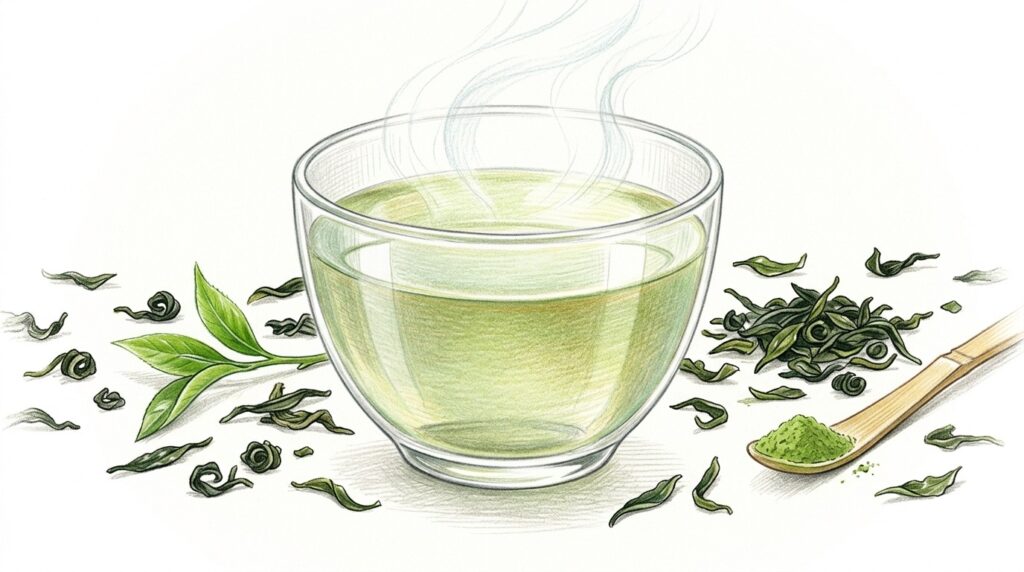
If you’re looking for a simple daily habit that may help support healthy uric acid levels, green tea and gout is a connection worth understanding.
Green tea deserves your attention.
The research behind green tea and gout is genuinely interesting, and it targets the same enzyme that prescription medications like allopurinol go after.
Here’s what’s actually going on and how to make it work for you.
How Green Tea Affects Uric Acid
Your body produces uric acid using an enzyme called xanthine oxidase.
The more active that enzyme is, the more uric acid you produce.
Green tea contains catechins, a group of polyphenols that have been shown to inhibit xanthine oxidase activity.
The most potent of these is EGCG (epigallocatechin gallate).
A 2022 study published in Food & Nutrition Research confirmed that tea and its components reduce uric acid production by inhibiting xanthine oxidase.
Green tea showed significantly stronger inhibition than black tea, largely because green tea is unfermented and retains higher levels of catechins.
Green tea may help reduce how much uric acid your body produces in the first place.
There’s a second mechanism too.
Research in the Journal of Ethnopharmacology found that green tea polyphenols also support uric acid excretion through the kidneys by influencing renal urate transporters.
So it’s potentially working on both sides: less production and more excretion.
The EGCG Factor
EGCG is the standout compound in green tea.
It makes up roughly 50-80% of the total catechin content in a typical cup.
Research has shown that EGCG specifically inhibits xanthine oxidase in a dose-dependent manner, meaning higher concentrations have a stronger effect.
Here’s the important nuance: the effect appears to be more pronounced in people who already have elevated uric acid levels.
Studies suggest green tea extract can decrease serum uric acid in people with high levels while having a neutral or even slightly raising effect in people with normal levels.
If you’re dealing with high uric acid, the research suggests green tea may be more helpful for you than for someone with normal levels.
Caffeine and the Diuretic Effect
Green tea contains caffeine, though less than coffee.
Caffeine has a mild diuretic effect, which means it increases urine output.
More urine output means more opportunity for your kidneys to flush uric acid.
The diuretic effect of caffeine is mild and your body adapts to it over time.
The xanthine oxidase inhibition from catechins is the real story here.
Caffeine itself is a methylxanthine, which is metabolised differently from the purines in food.
Studies have consistently shown that caffeine from tea and coffee does not raise uric acid levels.
How Much Green Tea Should You Drink?
The research doesn’t point to one exact dose, but here’s what the evidence suggests:
- 2-4 cups per day is the range most studies have used
- Higher catechin content means more potential benefit
- Brewing time matters: steep for 3-5 minutes to extract more catechins
- Quality matters: loose-leaf green tea generally contains more catechins than tea bags
If you’re not a tea drinker, green tea extract supplements are an option.
Most studies using extracts have used doses standardised to provide 200-400mg of EGCG.
Consistency is key.
One cup of green tea after a big steak dinner isn’t going to do much.
Daily consumption as part of a broader approach is where you’ll see the benefit.
Green Tea vs Black Tea
Green tea is better for gout support than black tea.
Black tea is fully fermented, which converts catechins into theaflavins and thearubigins.
These compounds have their own health benefits, but they’re less effective at inhibiting xanthine oxidase.
Green tea is unfermented, so it retains its catechins, including EGCG.
The 2022 Food & Nutrition Research study found that the degree of fermentation is inversely proportional to the tea’s ability to inhibit uric acid production.
White tea, which is minimally processed, may be even better than green tea on this front, though there’s less research specifically on white tea and gout.
What About Matcha?
Matcha is essentially concentrated green tea.
Instead of steeping leaves and discarding them, you’re consuming the whole leaf ground into powder.
This means you’re getting significantly more catechins per serve than a standard cup.
Some estimates suggest matcha provides 3 times the EGCG of regular green tea.
Matcha also contains more caffeine.
If you’re sensitive to caffeine or drinking it later in the day, keep that in mind.
One cup of matcha may deliver the catechin equivalent of 2-3 cups of regular green tea.
Just don’t add sugar to it, as fructose raises uric acid independently.
The Bottom Line
Green tea is one of the simplest additions you can make to support healthy uric acid levels.
It inhibits the same enzyme that allopurinol targets, it supports kidney excretion, and it comes with a long list of other health benefits.
Here’s how to make it work:
- Drink 2-4 cups daily of quality green tea, or 1-2 cups of matcha
- Steep properly for 3-5 minutes to maximise catechin extraction
- Skip the sugar and sweeteners
- Be consistent rather than occasional
- Combine it with other evidence-based strategies
Green tea on its own isn’t going to solve a serious uric acid problem.
As part of a targeted approach that includes diet, hydration, and the right supplementation, it’s a genuinely useful tool.
URICAH contains 14 clearly labelled natural ingredients, including tart cherry extract and celery seed extract, both of which also inhibit xanthine oxidase. No proprietary blends. 90-day money-back guarantee. 2,200+ reviews. Free shipping across Australia.
This article is for informational purposes only and is not intended as medical advice. Consult your healthcare provider before making changes to your health routine.

URICAH! Uric Acid Support
4.8 / 5
read 2,446 customer reviews
$39 AUDTHIS IS YOUR URICAH MOMENT
Our 14 potent, natural ingredients support the body in lowering uric acid levels, alleviating the excruciating pain and discomfort caused by gout.
URICAH™ features powerful ingredients used over thousands of years to fight gout such as Tart Cherry, Celery Seed and Chanca Piedra.
Get back on your feet and live pain free with URICAH™.
LEARN MORE