
You are probably aware that diet affects gout.
You may know that alcohol plays a role. That dehydration matters. That stress is a trigger.
But sleep? Most people never consider it.
That is a mistake. Poor sleep is one of the most overlooked contributors to gout flares and elevated uric acid. And sleep apnea, a condition affecting millions of Australians, increases your gout risk by 86%.
This is not the same as dealing with a gout flare at night. Our guide on gout flares at night covers why attacks tend to strike during sleep hours. This article is about something different: how the quality of your sleep directly influences whether flares happen in the first place.
How poor sleep raises uric acid
When you sleep poorly, your body responds in ways that directly affect uric acid levels.
Cortisol rises
Sleep deprivation is a physiological stressor. Your body responds by producing more cortisol.
Even a single night of poor sleep elevates cortisol the following day. Chronic poor sleep keeps cortisol elevated continuously.
Elevated cortisol promotes tissue breakdown, releasing purines into your bloodstream. Those purines are converted to uric acid by your liver.
Cortisol also impairs kidney efficiency. Since your kidneys are responsible for clearing around two-thirds of your body’s uric acid, any reduction in their function means more uric acid stays in your blood.
More produced. Less excreted. Levels climb.
The stress-gout connection is one we cover in detail in our guide on stress and gout. Poor sleep is one of the most common and least recognised sources of chronic physiological stress.
Inflammation increases
Sleep restriction drives up systemic inflammation.
Research published in the journal Sleep showed that limiting healthy adults to four hours of sleep for just six nights significantly increased C-reactive protein and interleukin-6, two key inflammatory markers.
Gout is fundamentally an inflammatory condition. When background inflammation is already elevated from poor sleep, it takes less provocation to trigger a full flare.
Think of it like this: poor sleep lowers your threshold. Things that might not have caused a flare on a good week of sleep can push you over the edge on a bad one.
Insulin resistance develops
This one surprises most people.
Sleeping six hours instead of eight for just four consecutive nights is enough to produce insulin resistance comparable to pre-diabetes, according to research from the University of Chicago.
Insulin resistance directly impairs uric acid excretion. It tells your kidneys to reabsorb more uric acid rather than clearing it into your urine.
This is one of the core mechanisms linking metabolic syndrome and gout. You can read more in our guide on gout and diabetes.
Dehydration concentrates uric acid
You lose meaningful amounts of water overnight through breathing and perspiration.
If you go to bed even mildly dehydrated, or sleep in a warm room, you wake up with concentrated blood and correspondingly concentrated uric acid.
This is partly why early morning is such a common time for uric acid to peak and flares to strike.
Our guide on dehydration and gout covers the hydration picture comprehensively.
Sleep apnea: the hidden gout driver
Sleep apnea is where the sleep-gout connection becomes impossible to ignore.
Obstructive sleep apnea (OSA) causes your airway to repeatedly collapse during sleep, cutting off oxygen for seconds at a time. This can happen dozens or even hundreds of times per night.
Research from Harvard found that people with OSA have an 86% higher risk of elevated uric acid compared to those without the condition.
An 86% increase. From a condition many people do not know they have.
The mechanism is clear
When your oxygen levels drop (a state called hypoxia), your cells cannot produce energy normally. They switch to a backup process that breaks down ATP, your cellular energy molecule.
The breakdown of ATP produces purines. Purines are converted to uric acid.
Repeated oxygen deprivation throughout the night creates a massive increase in purine turnover. Your liver converts all of it to uric acid.
Simultaneously, the intermittent oxygen deprivation impairs kidney function, reducing uric acid clearance.
You produce more. You excrete less. It is a compounding problem.
Do you have sleep apnea?
An estimated 1 in 4 Australian men and 1 in 10 Australian women have some form of obstructive sleep apnea.
Many are undiagnosed because the symptoms, tiredness, snoring, waking unrefreshed, morning headaches, are easily dismissed as normal.
Signs worth investigating:
- Regular loud snoring
- Excessive daytime sleepiness despite spending enough time in bed
- Waking with a dry mouth or headache
- A partner noticing you stop breathing or gasp during sleep
- Difficulty concentrating during the day
- Being overweight, particularly around the neck
If any of these sound familiar and you have gout, get a referral for a sleep study. It could be one of the most important things you do for your gout management.
CPAP treatment lowers uric acid
Continuous positive airway pressure (CPAP) is the standard treatment for moderate to severe sleep apnea. It keeps your airway open with gentle air pressure delivered through a mask.
A study in the European Respiratory Journal found that consistent CPAP use over several months significantly reduced serum uric acid levels in patients with moderate to severe OSA.
By restoring proper oxygenation during sleep, CPAP stops the cycle of hypoxia-driven purine breakdown. Less ATP gets broken down. Fewer purines are produced. Less uric acid accumulates.
If you have gout and sleep apnea, CPAP is not just a sleep treatment. It is a gout treatment.
When gout disrupts sleep
The relationship runs both ways.
Gout flares commonly strike at night. The pain is severe enough to wake you from deep sleep. One bad flare can destroy a week of sleep.
And that lost sleep then raises cortisol, increases inflammation, and worsens insulin resistance. Which raises uric acid. Which makes the next flare more likely.
It is a vicious cycle.
Breaking it means addressing both sides. Manage your uric acid to prevent flares that wreck your sleep. And manage your sleep to prevent the metabolic disruption that raises uric acid.
Practical sleep strategies for gout management
These are not luxury recommendations. They are part of an effective gout management protocol.
Maintain a consistent sleep schedule
Go to bed and wake at the same times every day, including weekends.
Your circadian rhythm controls cortisol production, melatonin release, and kidney filtration rates. Irregular sleep patterns disrupt all three and make uric acid management harder.
Keep your bedroom cool and dark
Aim for 16-18 degrees Celsius.
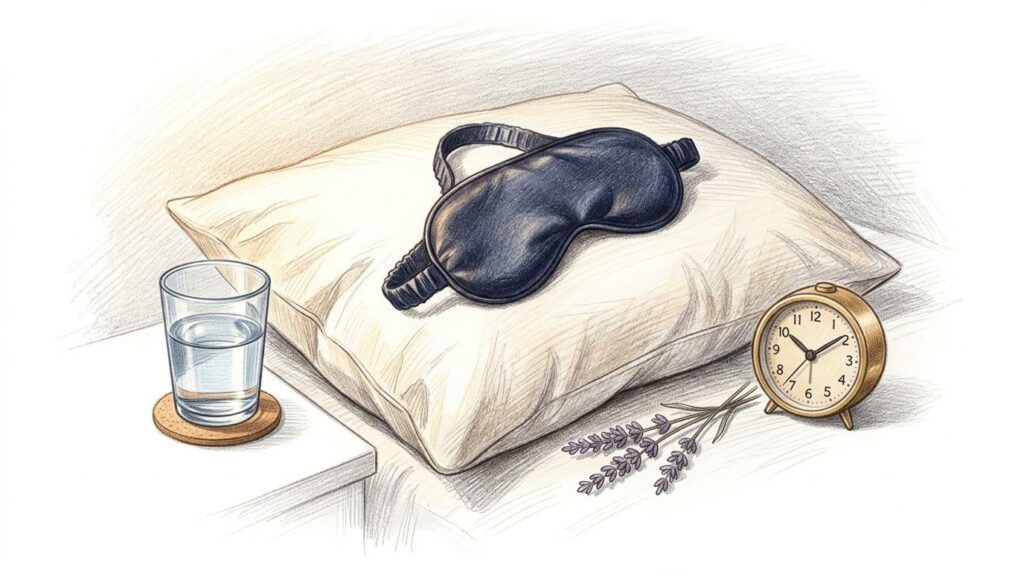
A warm room increases sweating and accelerates dehydration overnight. Use blackout curtains or an eye mask to support melatonin production.
Hydrate strategically
Stay well hydrated throughout the day. Do not try to make up for poor daytime hydration at bedtime, as that just means disrupted sleep from bathroom trips.
A small glass of water before bed helps offset overnight fluid loss. Keep water by the bed.
Cut caffeine by early afternoon
Caffeine has a half-life of five to six hours. A 2pm coffee is still 50% active at 7pm and 25% at midnight.
If you are sensitive to caffeine, noon should be your cutoff.
Limit evening alcohol
Alcohol helps you fall asleep but severely fragments sleep quality. You get less deep sleep and less REM sleep.
And alcohol raises uric acid directly. A nightcap is working against you on both fronts.
Manage stress before bed
If you lie awake with a racing mind, your cortisol is elevated at the exact time it should be at its lowest.
Simple strategies help: deep breathing, reading a physical book, writing down tomorrow’s tasks so your brain can let go.
Address weight
Excess weight is a risk factor for both gout and sleep apnea.
Extra weight around the neck increases airway collapse risk during sleep. Extra weight anywhere increases uric acid production through higher purine turnover and insulin resistance.
Weight loss can improve or even resolve sleep apnea while simultaneously lowering uric acid.
Our guide on obesity, weight, and gout covers safe, effective approaches.
The bigger picture
Sleep is not separate from gout management. It is embedded in it.
Poor sleep raises cortisol, increases inflammation, promotes insulin resistance, and dehydrates you. Sleep apnea directly drives uric acid production through oxygen deprivation.
You can eat perfectly, stay hydrated, avoid alcohol, and take every supplement available. If you are sleeping poorly, you are fighting with one hand tied behind your back.
Prioritise seven to eight hours of quality sleep. Keep it consistent. Stay cool and hydrated. And if there is any possibility you have sleep apnea, get tested.
It might be the most impactful change you make.
This article is for informational purposes only and is not intended as medical advice. Consult your healthcare provider before making changes to your health routine.

URICAH! Uric Acid Support
4.85 / 5
read 2,290 customer reviews
$39 AUDTHIS IS YOUR URICAH MOMENT
Our 14 potent, natural ingredients support the body in lowering uric acid levels, alleviating the excruciating pain and discomfort caused by gout.
URICAH™ features powerful ingredients used over thousands of years to fight gout such as Tart Cherry, Celery Seed and Chanca Piedra.
Get back on your feet and live pain free with URICAH™.
LEARN MORE